
Loop Engineering for Enterprise AI Agents
Recently, I read insightful posts from Matt Van Horn and Addy Osmani about Loop Engineering. This concept extends beyond demos and prototypes, particularly as we begin to develop AI agents for production-grade enterprise applications.
When many developers first experiment with AI agents, the workflow typically involves:
- Writing a prompt
- Reviewing the output
- Asking the agent to fix issues
- Repeating until the output meets expectations
In this scenario, the developer remains the loop. While this approach works for testing ideas or building quick prototypes, enterprise systems require more than just "it looks good." They demand predictable execution, validation, auditability, security, cost control, and clear failure handling.
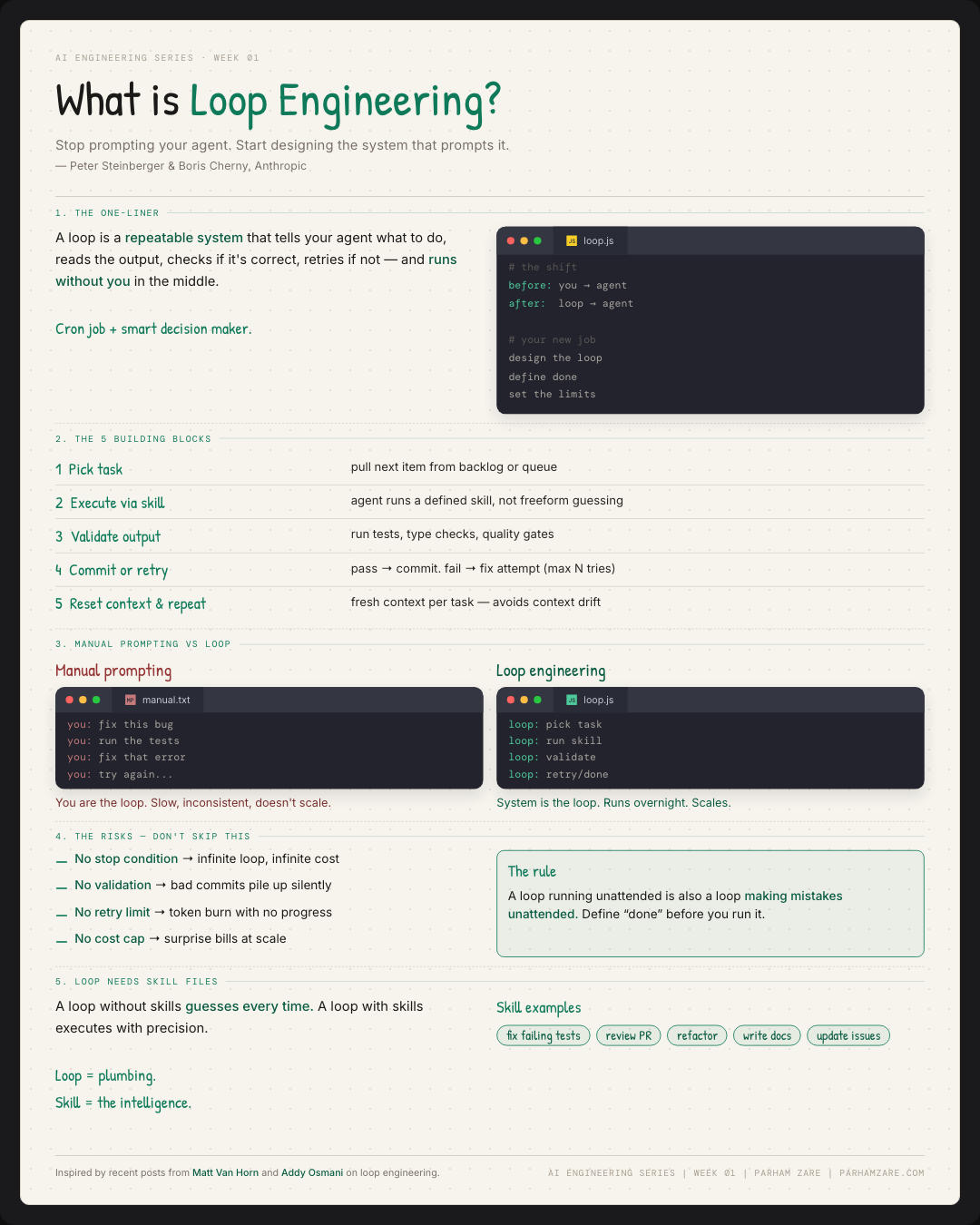
Where Loop Engineering Becomes Crucial
To me, Loop Engineering focuses on designing repeatable and controllable agent workflows that can:
- Select and execute a task
- Validate the result against clear criteria
- Retry or refine when something fails
- Stop when the Definition of Done is met
- Escalate safely when the agent cannot continue reliably
The Loop Primitive Is Not the Complete Solution
Frameworks like Google's Agent Development Kit provide useful building blocks for this pattern, such as LoopAgent, shared state, iteration limits, and termination conditions. However, having a loop primitive does not automatically make an agent workflow enterprise-ready.
As developers and architects, we must define key aspects:
- What "done" actually means and what should be validated
- Where human approval is necessary
- The retry, time, and cost limits
- How to log, audit, debug, and recover from failures
In enterprise environments, Loop Engineering is not about allowing agents to run indefinitely. It is about ensuring agent workflows are reliable, observable, secure, and bounded. Without proper validation and guardrails, an unattended loop can repeat mistakes more quickly and at a larger scale.
A Bounded Google ADK Example
I created a small example using Google ADK to demonstrate a clean and bounded workflow:
1generate -> validate -> refine -> stopYou can find the complete source code and workflow example here:
Google ADK Loop Engineering example on GitHub
My Takeaway
Frameworks provide orchestration, while engineering creates trust.
I am curious to hear how others are approaching this. If you are building agentic systems in production, how are you considering loops, validation, and reliability?